PASSIVE VOICE

Definition of Passive Voice

Passive Voice function
To
explain sentences where the subject is an inanimate object
The first
function of the passive voice is to explain sentences whose subject cannot do a
verb. Or in short, if the subject is an inanimate object. What is
meant by inanimate objects here is not only physical objects, but also abstract
objects, such as thoughts, values, feelings, and the like.
Example:
§ Those
buildings were ruined by weather anomaly (passive voice)
§ The
weather anomaly ruined those buildings (active voice)
Now try
to compare the two examples above, the first sentence uses the passive voice
and the second uses the opposite. At first glance, there is no obvious
difference between the two sentences of the passive and active voice. In
fact, the first sentence is easier to read than the second sentence. Especially
if the sentence above is included in a news or report.
To
Describe an Event for which the Perpetrator is Unknown
The
second function of the passive voice is to explain a sentence whose subject is
not known with certainty. Due to this, the object of the final sentence
has to be the subject in order for the sentence to be understood.
Example:
§ My wallet
was stolen when I strolled on this way (passive)
§ Someone
stole my wallet when I strolled on this way (active)
Literally,
the two examples above make sense ,
but the second sentence seems less effective. So since the culprit is
unknown, it's better to use the first sentence which uses the passive voice
form.
To describe an event whose object is more important than
the subject
The third
function of the passive voice is to describe events that focus on the object,
not on the subject. This means that the object of the sentence is much
more important to discuss than the subject.
This type
of sentence can be found in scholarly presentations or other focused
discussions. So for example, there is a meeting with the aim of reviewing
"robots with human intelligence". So the focus of the meeting
was a discussion of the object "robots with human intelligence".
Example:
§ The
experiment is conducted between June and September 2019 in Komodo Island,
Indonesia (passive)
§ We conducted
the experiment between June and September 2019 in Komodo Island, Indonesia
(active)
The focus
of the two examples above is actually the same, namely telling about an
experiment. However, if the second sentence is used, it is as if the focus
is the activities of the person conducting the experiment, not the experiment. From
this alone it is clear that in this condition, the passive voice is more
appropriate.
To Describe Two Events in One Sentence
Well,
here comes the passive voice function that people rarely talk about! The
passive voice can be used in sentences that want to include two or more verbs. One
goal: so that the sentence sounds varied. Now as an example, try to
compare the two sentences below:
Example:
§ When Faza
went to school, some punk kids beat her and confiscate her pocket money
§ When Faza
went to school, she was beaten and her pocket money is confiscated by some punk
kids
Again,
the two sentences above do not have a significant difference. However, for
storytelling, generally the sentence form like the second example is preferred.
Passive Voice Formulas
The
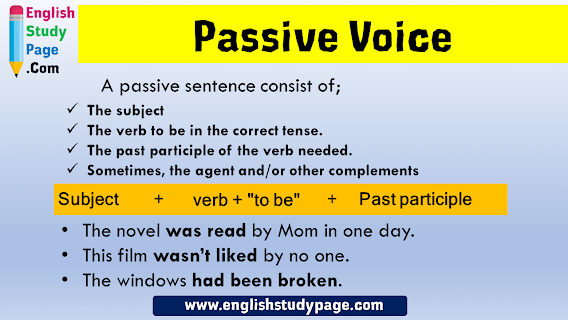
passive voice is formed from the auxiliary verb and past participle (verb-3).
|
auxiliary verb + past participle |
Auxiliary
verbs used in passive
voice can be:
·
primary auxiliary verb "be"
(is, are, am, was, were),
·
a combination of two primary
auxiliary verbs (is / are being, was / were being, has /
have been), or
·
combination of primary
auxiliary verb and modal auxiliary verb (will be, will have
been)
The past participle used is
a transitive verb . Past participles are obtained
by adding -ed, -en, -d, -t, -n, or -ne to the base form, which are regular verbs . In the base form, it is an irregular verb , the past participle is
inconsistent.
1.
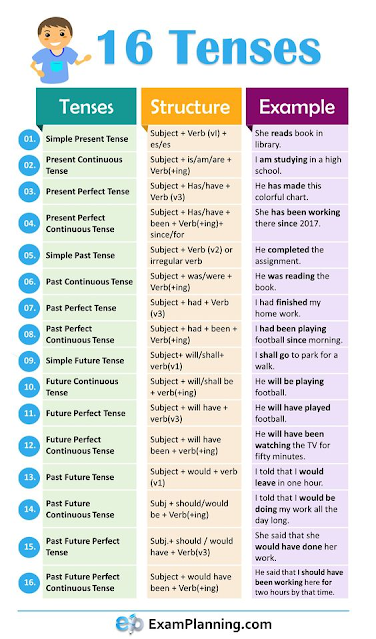
Simple Present Tense
Aktif : S + do/does + V1
Pasif : S + to be (am, are, is) + V3 + by + O
example:
Aktif : Students speak English
Pasif : English is spoken by students
2.Present Continuous Tense
Aktif : S + to be (am, are, is)
+ V1-ing + O
Pasif : S + to be (am, are, is) + being + V3 + by + O
example :
Aktif : Students is speaking English
Pasif : English is being spoken by students
3. Present Perfect Tense
Aktif : S + have/has + V3 + O
Pasif : S + have/has + been + V3 + by + O
example :
Aktif : Students have spoken English
Pasif : English has been spoken by students
4. Present Perfect Continuous Tense
Aktif : S + have/has + been +
V1-ing + O
Pasif : S + have/has + been + being + V3 + by + O
example :
Aktif : Students have been speaking English
Pasif : English has been being spoken by students
Aktif : S + V2 + O
Pasif : S + to be (was, were) + V3 + by + O
example :
Aktif : Students spoke English
Pasif : English was spoken by students
6.
Past Continuous Tense
Aktif : S + to be (was, were) +
V1-ing + O
Pasif : S + to be (was, were) + being + V3 + by + O
example :
Aktif : Students were speaking English
Pasif : English was being spoken by students
7. Past Perfect Tense
Aktif : S + had not + V3 + O
Pasif : S + had + been + V3 + by + O
example :
Aktif : Students had spoken English
Pasif : English had been spoken by students
8. Past Perfect Continuous Tense
Aktif : S + had + been + V1-ing
+ O
Pasif : S + had + been + being + V3 + by + O
example :
Aktif : Students had been speaking English
Pasif : English had been being spoken by students
9. Simple Future Tense
Aktif : S + will not + V1 + O
Pasif : S + will be + V3 + by + O
example :
Aktif : Students will speak English
Pasif : English will be spoken by students
10. Future Continuous Tense
Aktif : S + will + be + V1-ing
+ O
Pasif : S + will + be + being + V3 + by + O
example :
Aktif : Students will be speaking English
Pasif : English will be being spoken by students
11. Future Perfect Tense
Aktif : S + will + have + V3 + O
Pasif : S + will + have + been + V3 + by + O
example :
Aktif : Students will have spoken English
Pasif : English will have been spoken by students
12. Future Perfect Continuous Tense
Aktif : S + will + have + been
+ V1-ing + O
Pasif : S + will + have + been + being + V3 + by + O
example :
Aktif : Students will have been speaking English
Pasif : English will have been being spoken by students
13. Simple Future Past Tense
Aktif : S + would + V1 + O
Pasif : S + would + be + V3 + by + O
example :
Aktif : Students would speak English
Pasif : English would be spoken by students
14. Future Past Continuous Tense
Aktif : S + would + be + V1-ing
+ O
Pasif : S + would + be + being + V3 + by + O
example :
Aktif : Students would be speaking English
Pasif : English would be being spoken by students
15. Future Past Perfect Tense
Aktif : S + would + have + V3 +
O
Pasif : S + would + have + been + V3 + by + O
example :
Aktif : Students would have spoken English
Pasif : English would have been spoken by students
16. Future Past Perfect Continuous
Tense
Aktif : S + would + have + been
+ V1-ing + O
Pasif : S + would + have + been +being + V3 + by + O
example :
Aktif : Students would have been speaking English
Pasif : English would have been being spoken by students
Changing Active Voice to Passive Voice
Active or normal voice can be transformed into a passive
voice (the process is called passivization ) with the following
scheme.
|
active voice |
passive voice |
|
subject (doer of action) +
+
object (receiver of action) |
subject (receiver of action) +
auxiliary verb +
past participle (verb) +/-
by ... (doer of action) |
The
doer of action (actor action) expressed in by-phrase in
the passive voice is usually not mentioned. The
term construction of sentences in passive voice which
the actor does not mention is short passive or agentless
passive . The reasons are, among others, because the
perpetrators of the action are unknown, unimportant or interesting, to avoid
responsibility, or sentences constitute academic writing ,
especially those related to science (science).
Passive Voice Formulas for various tenses
|
tense |
active voice |
passive voice |
|
verb-1 |
am / is / are + verb-3 |
|
|
am / is / are + -ing |
am / is / are + being + -ing |
|
|
have / has + verb-3 |
have / has + been + verb-3 |
|
|
verb-2 |
was / were + verb-3 |
|
|
was / were + -ing |
was / were + being + verb-3 |
|
|
had + verb-3 |
had + been + verb-3 |
|
|
will + bare infinitive |
will + be + verb-3 |
|
|
am / is / are going to + bare infinitive |
am / is / are going to + be + verb-3 |
|
|
will + have + verb-3 |
will + have + been + verb-3 |
Examples of Passive Voice Sentences in Several Tenses
|
1 |
I am paid in dollars. |
|
2 |
My shoes are washed every
month. |
|
3 |
The book was edited by
Beatrice Sparks. |
|
4 |
The store will be closed . |
|
5 |
The room is being cleaned
now. |
Passive Voice Form
Passive
Voice Forms With Tenses
The passive voice or active
voice in English consists of two elements, namely the
appropriate form of the verb to be + past
participle
Examples of sentence forms:
- Singular
- positive
sentence: The house was built in 2010
- negative
sentence: The house was not built in 2010
- Question:
Was the house built in 2010?
- Negative
question sentence: Was not the house built in 2010?
- Plural
- positive
sentence: These houses were built in 2010
- negative
sentence: These houses were not built in 2010
- Interview:
Were these houses built in 2010?
- Negative
question sentence: Were not these houses built in 2010?
Example sentences using the word Clean
·
Present Tense: "The school is cleaned everyday"
·
Present Continuous Tense: "The school is being cleaned at
the moment"
·
Past Tense: “The school was cleaned two days ago”
·
Past Continuous Tense: "The school was being cleaned last
month"
·
Present Perfect Tense: "The school has been cleaned since
they left"
·
Past Perfect Tense: “The school had been cleaned before they
arrived”
·
Future Continuous Tense: "The school will be being cleaned
if we had the ceremony"
·
Future Tense: "The school will be cleaned tomorrow"
Forms
of passive voice with infinitives
The passive infinitive is used
after a modal verb (modal verb) and other verbs are generally followed by an infinitive .
Example sentence: "Raisa wants to
be invited to the party"
Form
the passive voice with the gerund
The gerund is used after a preposition or
preposition, and verbs are usually followed by a gerund .
Example: "Most Artists hate
being interviewed "
Form
of passive voive with to be born
The to be born form
is the passive form that is usually used in the past tense form . However,
in some cases it can also be used in the present and future
tense forms .
Example: "My sister was born in 2016".
Passive Voice Sentences and Examples
1.
Passive voice is used
when the doer of action is
unknown.
Examples
of Active and Passive Voice Sentences
|
Active |
Passive |
|
Someone knocked on your door last night. |
Your door was knocked on
last night. |
|
Somebody has used the
computer without permission. |
The computer has been used without
permission. |
2.
Passive voice is used
when the doer of action is not
important to mention (for example, because the actor of the action is clear /
predictable or refers to people in general).
Examples
of Active and Passive Voice Sentences
|
Active |
Passive |
|
You can view the final results on the
internet. |
The final results can be viewed on
the web. |
|
People rarely do this
intentionally. |
This is rarely done intentionally. |
|
The teacher instructed the
students to solve the math problem. |
The students were instructed to
solve the math problem. |
3.
Passive voice is used
to emphasize objects .
Examples
of Active and Passive Voice Sentences
|
Active |
Passive |
|
Sunmark Press published The Enzyme Factor at
the first time in 2005. |
The Enzyme Factor was published at the first time in
2005 by Sunmark Press. |
|
I have to collect more than
20,000 dollars to buy the car. |
More than 20,000 dollars have to be
collected to buy the car. |
4.
The passive voice is used
as a variation on writing (for example, the actor in the action has been
mentioned in the previous sentence).
Examples
of Active and Passive Voice Sentences
|
Active |
Passive |
|
The investigators knew that she had returned
to Indonesia. They arrested her
yesterday. |
The investigators knew that she had returned
to Indonesia. She was
arrestedyesterday. |
Exceptions
to Transitive Verbs
Not all transitive verbs ,
verbs that have a direct
object , can be passive. Some verbs like have , become , lack , look like , and mean sound
unnatural when they are passive.
Examples
of Unsaidable Verb Sentences
|
I have a great new idea. |
|
cannot be passive to be A great new idea is had by me . |
|
It contains only natural ingredients. |
|
Cannot be passive ingredients are contained by it . |
Below is also my video explaining the passive voice
Dialogue about passive voice
okey, next we will discuss
dialogue about passive voice. let's see my dialogue below.
Yuli : Lent,
you look different today. Why you didn’t wear your usual glasses?
Valent: My
usual glasses is being repaired in the optic. I broke the lenses yesterday.
Yuli : I
hope the repair goes well and you can use your usual glasses again, Lent.
Valent: Thank
you, I hope so. This glasses is really uncomfortable and I want to wear my
usual glasses again.
Conclusion:
From the above dialogue, we
can conclude that there is a passive voice sentence, namely my usual glasses
are being repaired (my usual glasses are being repaired). My usual glasses are
subjects subject to action, namely being repaired. This sentence uses to be is
being (being) which indicates the action is running or the present continuous
tense.
Meanwhile, the word broke in
the example dialogue is not a passive voice sentence form. The word broke which
is used is an active sentence that uses the verb in the past form, or the past
tense.
My video
This my video about dialogue passive voice
Readers can also see other examples of dialogue below
Then There Is A Song That Has A Passive Voice Sentence
Which Is Entitled "Just Give Me A Reason"
the lyrics of the song just give me a reason along with
the passive voice
“Just
Give me A Reason”
Right from the start
You were a thief, you stole my heart
And I, your willing victim
I let you see the parts of me, that weren't all that pretty
And with every touch you fixed them
Now you've been talking in your sleep oh oh
Things you never say to me oh oh
Tell me that you've had enough
Of our love, our love
Just give me a reason, just a little bit's
enough
Just a second we're not broken just bent, and we can learn to love again
It's in the stars, it's been written in the scars on our hearts
We're not broken just bent, and we can learn to love again
I'm sorry I don't understand
Where all of this is coming from
I thought that we were fine (oh we had everything)
Your head is running wild again
My dear we still have everythin'
And it's all in your mind (yeah but this is happenin')
You've been havin' real bad dreams oh oh
You used to lie so close to me oh oh
There's nothing more than empty sheets between our love, our love
Oh our love, our love
Just give me a reason, just a little bit's
enough
Just a second we're not broken just bent and we can learn to love again
I never stop, you're still written in the scars on my heart
You're not broken just bent and we can learn to love again
Oh tear ducts and rust
I'll fix it for us
We're collecting dust, but our love's enough
You're holding it in
You're pouring a drink
No nothing is as bad as it seems
We'll come clean
Just give me a reason just a little bit's
enough
Just a second we're not broken just bent and we can learn to love again
It's in the stars, it's been written in the scars on our hearts
That we're not broken just bent and we can learn to love again
Just give me a reason, just a little bit's
enough
Just a second we're not broken just bent, and we can learn to love again
It's in the stars, it's been written in the scars on our hearts
That we're not broken just bent, and we can learn to love again
Oh we can learn to love again
Oh we can learn to love again
Oh that we're not broken just bent and we can learn to love again
Conclusion
⇒ pink: Simple Past sentences
There are BE were which are used after the plural noun (in the song:
you, we, and the parts of me).
There is a Verb Simple Past / Verb 2 (irregular verb / irregular),
namely had (have) and thought (think) which indicate that this happened in the
past. In Simple Past Tense, the active sentence does not use BE, just Verb
Simple Past.
⇒ blue: Present Perfect Continuous sentence
The characteristics are have / has been (present perfect) and verb-ing
(continuous). Easy to recognize and remember from the name, right? Its function
is to explain something that has happened continuously from the past to the
present, and may still continue.
⇒ purple: Present Perfect sentence
You have had, well, look, there are Haves and Past Participles aka Verb
3 had. What is often mistaken here: distinguishes HAVE which means
"have" from HAVE which is an auxiliary verb. So what changes in the
Present Perfect is the Verb, not the assistant (auxiliary verb, that is). The
Present Perfect describes something that has happened or has repeatedly
happened since then until now.
⇒ red: Passive Voice in Present Perfect Tense
Passive Voice must have BE (which indicates the time form) and Past
Participle / Verb 3 (as in Indonesian). In this song, it's been written: well,
the first thing to do is the 's, here it must be HAS (is been written), meaning
that because it has been written, this sentence is Present Perfect. The BEEN
indicates the BE Passive Voice in the third form / Past Participle for the
Present Perfect.
⇒ green color: TO & Verb
Well, have to be careful with this shape. Usually, if there are 2 verbs
that are used together and the function is still as a verb, this TO will
appear, as in this song learn to love.
But to use to lie in this song USED TO means "used to or has become
a habit in the past". This USED is different from USE (means "to
use"; the infinitive / verb 1 form; regular verb).
So The Explanation From My Blog, Hope It Is Useful For All
Of Us. Thank You 😊😊💖💖